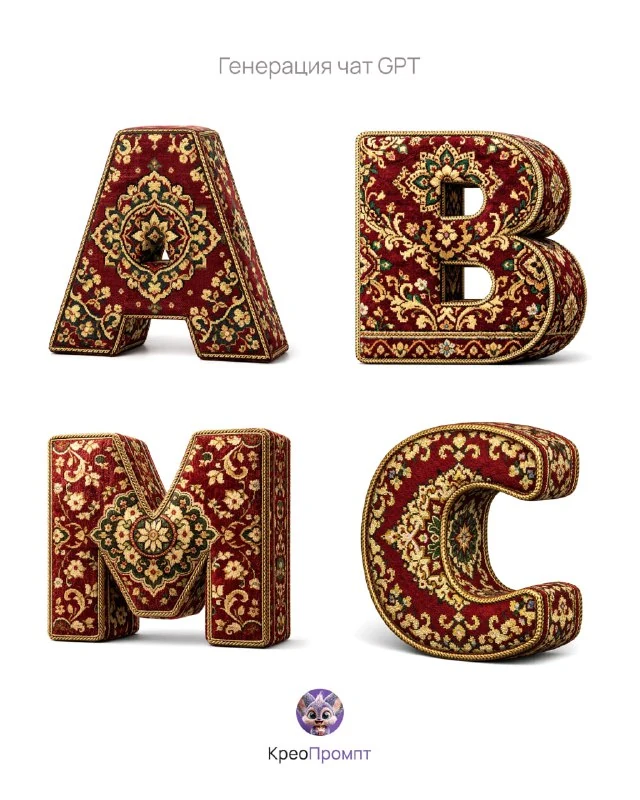
Start with one capital letter
The original prompt was published in Russian in the channel post. Below is its English translation for tools that use English prompts. This is a translation of the author's text, not a separate original English prompt. Replace Буква with one capital letter.
For the first attempt, choose a character with a broad surface, making the medallion and symmetrical pattern easier to see. A very thin letter leaves little room for ornament. Keep the same character while comparing fabric, lighting and pattern placement.
Translation of the original prompt
A letter with a carpet ornament — translated from the original
A three-dimensional uppercase letter “Буква”, fully wrapped in a continuous repeating pattern of a luxurious Soviet-style carpet with an elegant central medallion and refined symmetrical floral ornament. Rich ruby red and a deep oxblood base, with accents of antique gold, warm ivory and dark emerald.
Dense high-quality textile with a thick velvet-like pile, a subtle silky sheen in the threads, ultra-detailed fibers, and a perfectly aligned pattern across all surfaces without distortions or patchwork. Decorative raised carpet stitching follows the edges precisely.
Isolated on a pure white seamless studio background with plenty of copy space. Soft diffused key light with gentle rim lighting to enhance texture depth. Ultra-realistic textile detail, sharp focus, professional luxury product photography style, photorealism, 8K.The prompt specifies a ruby-red base, an oxblood tone, and accents of gold, ivory and dark emerald. These colours support the character of this particular carpet example. Avoid adding many new hues at once: first check that the ornament remains visible within this palette.
Dense pile and a slight silky sheen should retain a textile character. If the surface resembles glazed ceramic with a carpet painted on it, reduce mirror-like reflections and clarify the fibres. Texture matters as much as the pattern itself.
Trace the pattern's continuity
The original asks for a continuous repeating pattern without patchwork. Compare the front surface with the side. The pattern should continue around the volume rather than restart on each plane. Errors are particularly noticeable around internal openings and changes in stroke direction.
Place the central medallion on a broad part of the letter, but do not let it replace the character's outline with a separate round object. Check the overall silhouette in a small preview, then zoom in on pattern symmetry and joins. A complex character may require several versions with different ornament scales.
Check the pile, edges and light
Decorative stitching follows the edge, so it should explain the contour rather than cross it as an arbitrary line. On thin sections, stitches may become too large. Reduce their prominence if they start changing the letter's shape.
Soft studio lighting helps show the textile without deep dark areas. Check that lit and shaded sides convey depth while retaining the same material. An overly dark edge hides fibres; an overly bright highlight makes the surface look plastic. Compare these areas side by side rather than separately.
Use the character as one large element
Place this letter on a cover or section card and add a regular heading. Add the name and explanation in your editor: the original is designed for a single character. Do not assume the same prompt will automatically produce a long, even line with consistent ornament.
Leave a quiet area around the textile volume. The prompt's white background is not a transparent PNG; account for small edge fibres when removing it. Save the original letter, translated prompt and selected result. This lets you extend the series by comparing each new character with the approved texture.
Select the inscription for the next layout
Creative AI Typography contains 823 prompts with examples, search and effect categories. Start by trying 40 options with your own text in the free demo.