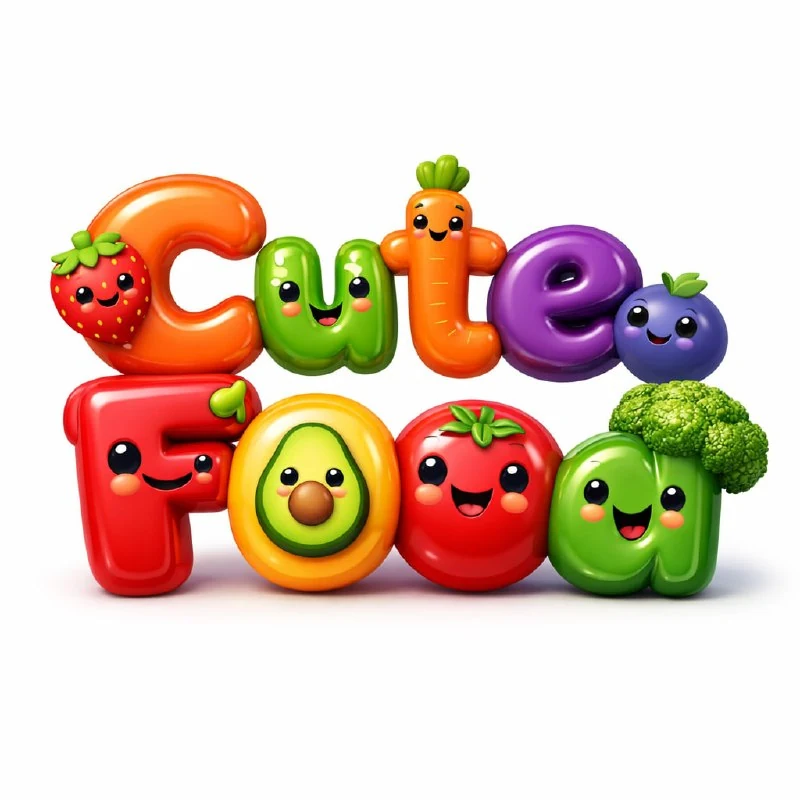
Decide on the lettering's personality
The prompt in the author's comment combines typography with smiling fruit and vegetables. Choose a short name for a food project or content series. Limit the number of letters for the first exercise so each can have a clear personality.
Set a shared mood: quiet smiles or more energetic cartoon faces. Avoid mixing many emotions at once. If one character looks frightened while the others are happy, viewers may infer a story you did not intend.
Include vegetables as well as fruit to keep the original idea. This is not lettering made from one uniform fruit texture: the important feature is different food characters forming a recognisable word.
The friendly-food prompt
Letters made from food characters
cute food typography "Your Text",
smiling fruits and vegetables,
rounded cartoon shapes,
bright healthy colors,
playful food mascots,
friendly brand style,
hyperrealistic 3D,
soft lighting,
macro details,
text only, isolated typography,
subtle shadow on white surface,
product photography, ultra detailed, 8kReplace Your Text with the required name. Smiling fruits and vegetables defines smiles and both food groups, while playful food mascots reinforces the character treatment. Rounded cartoon shapes requests soft, rounded forms.
The source combines a cartoon style with hyperrealistic 3D. In practice, interpret this as stylised characters with detailed lighting and surfaces, rather than documentary images of real vegetables. Check that materials and facial expressions work together.
Preserve the letter beneath the character's face
Read the word in a small preview before examining eyes and smiles. If the expression works but the character hides the letter's shape, the lettering fails its purpose. Clarify the main stroke and internal counter.
Eyes should not become new holes that change the character. Check similar-looking letters and rounded forms especially carefully. Move the face inside a broad stroke if needed, leaving the outline and counters clear.
If the result is a group of vegetables beside regular text rather than character-letters, clarify their role in the working prompt. Adding more food around the word strengthens the setting but does not change the lettering's construction.
Bring different foods into one visual system
Check eye scale, smile style and degree of rounding for consistency. A carrot can be long and a tomato round, but their face styles should connect them. A random mix of a realistic vegetable and a flat sticker looks inconsistent.
Choose a limited palette and one light direction. The prompt's bright colours do not require every element to be equally saturated. One strong accent can emphasise the beginning of the word or an important letter.
A white surface and small shadow support the volume. Check whether the characters genuinely occupy the same space. Different bases and mismatched shadows can make them look like separate pictures.
Build the name for a post
Place the lettering in your editor and add one short explanatory line in a regular font. Do not repeat faces in every informational word: the character heading already establishes the mood. Leave enough space around smiles and silhouettes.
Check the spelling letter by letter. If one character needs replacing, preserve its overall style and lighting. You need not regenerate the entire word for a small text error.
For another food treatment, see text made from fruit, where ingredient texture matters. Here, the focus is on character personality and its relationship to the letters. Save the clean lettering and layout separately to reuse the name at different sizes.
Select the inscription for the next layout
Creative AI Typography contains 823 prompts with examples. The demo offers 40 prompts: try different approaches to one name and compare readability.